



Introduction: The Critical Balance of Stretch and Performance
For procurement managers and product developers across apparel, textiles, What is the Acceptable Content of Elastic Yarn? A Comprehensive Guide to Specifications, Testing, and Application Standards home furnishings, and soft goods, the specification of elastic yarn is a pivotal technical decision with direct consequences for product fit, comfort, durability, and cost. The question “What is the acceptable elastic yarn content?” is deceptively simple. The answer is not a single percentage, but a spectrum determined by a complex interplay of fiber science, fabric construction, end-use mechanics, and rigorous international standards. This guide provides a deep technical dive into the factors governing elastic yarn content, translating complex concepts into actionable data and specifications for professional sourcing and quality assurance. By mastering these principles, you can optimize product performance, minimize returns, and ensure compliance in global markets.
Table of Contents
- Decoding Elastic Yarn: Beyond Spandex
- 1.1. Core Elastic Fibers: Spandex vs. Alternative Elastanes
- 1.2. The Mechanics of Stretch: Bare vs. Covered Yarn Constructions
- The Framework of “Acceptable Content”: Drivers and Determinants
- 2.1. Primary Driver: Garment Type and Functional Requirement
- 2.2. Fabric Construction: The Knit or Weave as a System
- 2.3. Performance Benchmarks and Industry Standards
- Application-Specific Analysis: Data-Backed Content Ranges
- 3.1. Apparel: From Sheer Hosiery to Performance Activewear
- 3.2. Home Furnishings and Technical Textiles
- 3.3. Special Considerations for Compression and Medical Textiles
- Specification, Testing, and Compliance: The Quality Assurance Protocol
- 4.1. Specifying Content: From Fiber to Fabric
- 4.2. Core Test Methods: ASTM, ISO, and AATCC Standards
- 4.3. Managing Tolerance and Ensuring Batch Consistency
- Strategic Sourcing and Cost-Performance Optimization
- 5.1. Calculating Cost-in-Use: The True Price of Elasticity
- 5.2. Future Trends: Sustainable Elastomers and Smart Stretch
1. Decoding Elastic Yarn: Beyond Spandex
Elastic yarn is engineered to provide durable recovery—the ability to stretch significantly and return to its original length. While spandex (a polyurethane-based fiber, with Lycra® being a prominent brand) is the global benchmark, the term “elastane” is its generic ISO designation. Alternative elastomeric fibers like creora® and roica® also exist, offering variations in dye affinity, chlorine resistance, or sustainability profiles (e.g., bio-derived content).
Crucially, spandex is almost never used as a bare filament in final fabric. It is integrated via two primary yarn constructions that directly impact “content” calculations:
- Covered Yarn: A spandex filament is completely wrapped (covered) by a hard yarn like nylon, polyester, or cotton. This fully conceals the elastane, protects it, and dictates the surface aesthetics.
- Core-Spun Yarn: The spandex filament forms the central core, surrounded by a sheath of staple fibers (e.g., cotton, wool, rayon) during spinning. This offers a more natural hand but can allow the core to “grin through” if not perfectly covered.
In both cases, the declared elastic content is the weight percentage of the pure elastane fiber within the final composite yarn.
2. The Framework of “Acceptable Content”: Drivers and Determinants
“Acceptable” is defined by achieving target performance within cost and durability parameters.
2.1. Primary Driver: Garment Type and Functional Requirement
The required degree and type of stretch are fundamental.
- Comfort Stretch (10-30% elongation): Provides ease of movement and fit retention. Common in woven shirts, blouses, and casual pants.
- Performance Stretch (30-100%+ elongation): Provides significant constriction and freedom of movement. Essential for activewear, swimwear, and foundation garments.
- Power/Compression Stretch: Engineered to exert specific, graduated pressure on the body for medical or athletic performance.
2.2. Fabric Construction: The Knit or Weave as a System
The fabric structure works synergistically with the elastane. A 10% spandex content in a tightly knit structure will behave differently than the same content in a loose weave. The fabric’s gauge, stitch/weave type, and finishing (e.g., heat setting) lock in the stretch and recovery properties, making final garment testing non-negotiable.
2.3. Performance Benchmarks and Industry Standards
“Acceptable” must be tied to measurable outcomes. Key standards include:
- ASTM D2594 / ISO 20932: Standard test methods for stretch properties of fabrics.
- ASTM D3107: Test for elastane content in textiles (chemical dissolution method).
- Specific Brand/Retailer Standards: Major brands often have proprietary, stringent test protocols for growth, recovery, and power retention over multiple wash cycles.
3. Application-Specific Analysis: Data-Backed Content Ranges
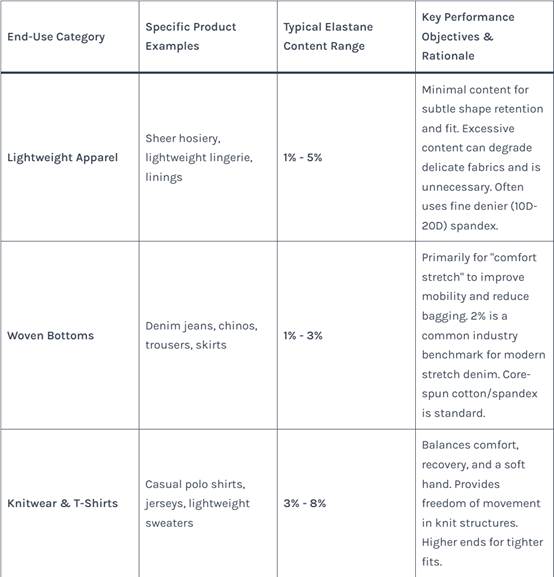
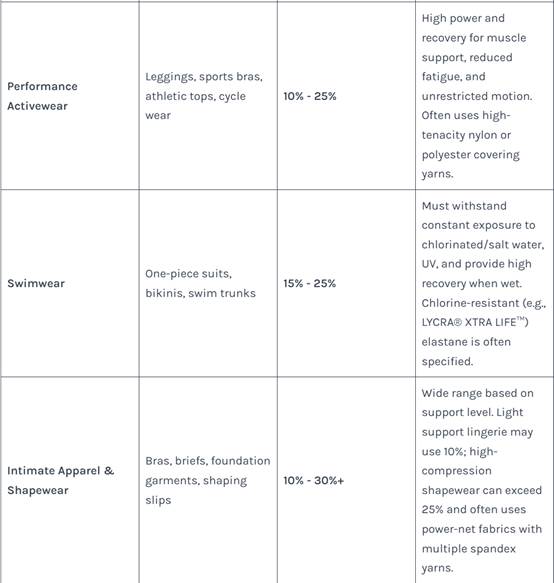
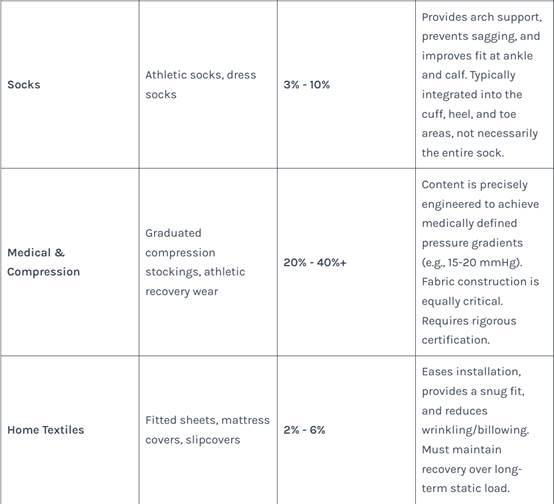
The following table provides evidence-based reference ranges. These are starting points for development; prototyping and testing are always required.
Table 1: Typical Elastane Content Ranges by Application and Fabric Type
4. Specification, Testing, and Compliance: The Quality Assurance Protocol
4.1. Specifying Content: From Fiber to Fabric
Your Technical Data Sheet (TDS) must be unambiguous. Example: “Fabric: 92% Cotton, 8% Spandex. Yarn Construction: Core-spun, 40 Ne Cotton sheath / 40 Denier Spandex core.” For critical applications, add: “Elastane Content Tolerance: ±0.5%.”
4.2. Core Test Methods
- Content Verification (ASTM D3107 / AATCC TM179): The spandex is dissolved out of a known fabric weight using a specific solvent (dimethylformamide – DMF), and the remaining mass is measured. The weight loss calculates the exact spandex percentage. This is the definitive test for compliance against specification.
- Performance Verification:
- Stretch & Growth (ASTM D2594): Measures extension under a defined force and permanent growth after a defined recovery time.
- Tension & Modulus (ASTM D4964): Measures force at various elongations, critical for compression wear.
- Power Retention (Cyclic Testing): Stretches fabric to a set extension for multiple cycles to simulate wear; measures loss of recovery force.
4.3. Managing Tolerance
Industrial dyeing and finishing can affect elastane content. A batch tolerance of ±0.5% to ±1.0% on a 5% spandex content specification is commercially typical. Tighter tolerances (<±0.5%) increase cost and require exceptional process control from the mill.
5. Strategic Sourcing and Cost-Performance Optimization
5.1. Calculating Cost-in-Use
Elastane is significantly more expensive than hard fibers like cotton or polyester. A 2% content increase can raise yarn cost by 10-15%. The strategic calculation is not minimizing cost, but optimizing for value: Does the added cost of higher elastane content yield a demonstrable improvement in product performance, customer satisfaction, and reduced returns that justifies the investment? For a premium legging, the answer is yes; for a basic t-shirt, it may not be.
5.2. Future Trends
The industry is moving towards:
- Sustainable Elastomers: Development of bio-based or recyclable elastane to address end-of-life environmental concerns.
- Enhanced Durability: Elastane with improved resistance to heat, chlorine, and oils for longer garment life.
- Smart Stretch: Integration of elastane with phase-change materials or conductive yarns for responsive textiles.
Conclusion
Determining the acceptable elastic yarn content is a precise engineering exercise, not a matter of guesswork. It requires a systematic approach that begins with a clear understanding of the end-use’s mechanical demands, proceeds through careful specification of both material content and construction, and is validated by rigorous, standardized testing. For the professional buyer, this knowledge is power: it enables clear communication with suppliers, establishes defendable quality benchmarks, and ensures that the final product delivers the intended experience of fit, comfort, and durability. By anchoring decisions in data and standards, you transform elasticity from a vague marketing claim into a precisely controlled, high-value technical attribute.